(We) Like It Like That

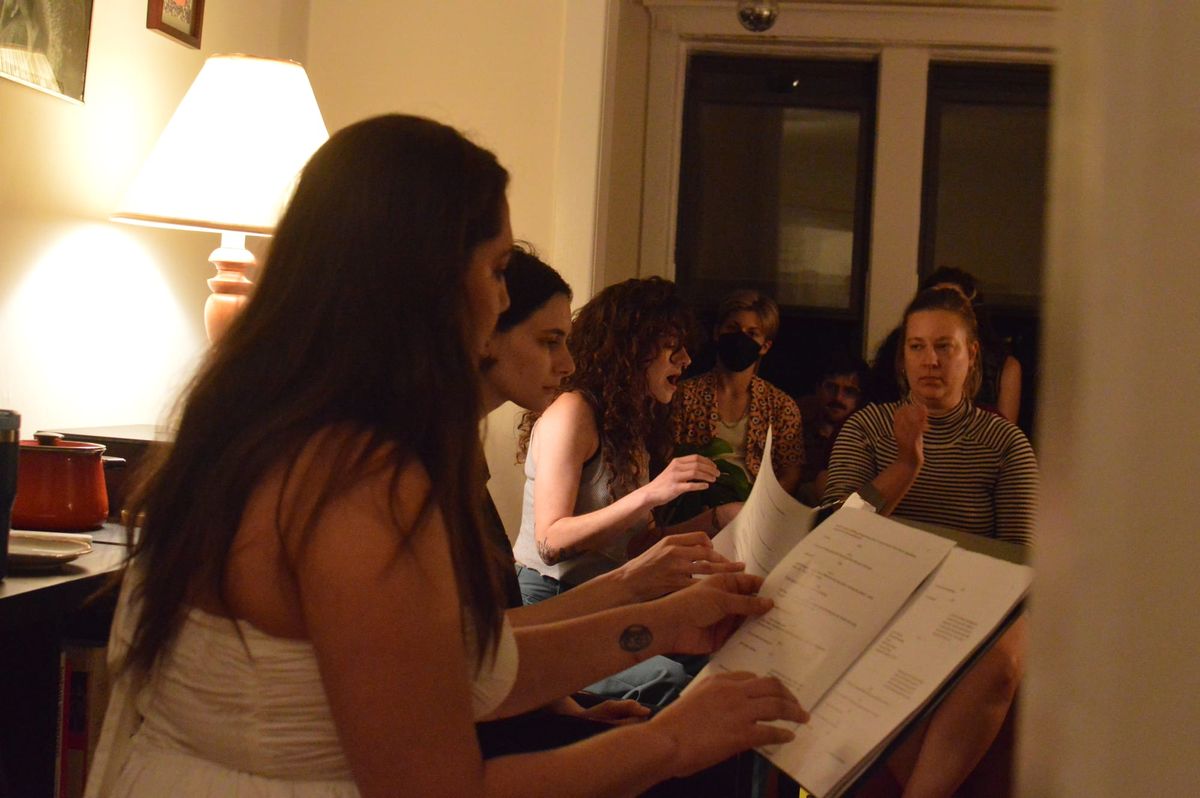
Here Are Some Plays We Like is a one-of-a-kind "half play reading, half party, and all one-of-a-kind theatre experience" produced by AJ Schwartz, a Chicago-based director who quite radically decided to ask artists what kind of work they would like to be making and hit the ground running a few years ago. I spoke to Schwartz about the upcoming season (which launches this Sunday, October 4th!) and the artist-first producing model behind Here Are Some Plays. Full disclosure: I will be making a rare acting appearance in the second play in the series, Adrienne Kennedy's Diary of Lights: New York About 1955, directed by Friend of Simpler Seph Mozes on October 11th. If you're in Chicago, come by is/was Brewing over the next few Sundays and enjoy the plays! And for now, enjoy my chat with AJ.
This is the first iteration of this project called Here Are Some Plays We Like, rather than “I”. Would you mind talking about that a little bit?
SCHWARTZ: Yes. This series started back in 2023, and at the time, I was freelance directing. I had a couple plays that I'd been pitching around, and I [felt] like, "No one's really biting on these, but I want to get them in front of an audience." So, I said, "Fuck it, I'll just do them in my living room." So I…brought in actors for both of them, paid everyone out of pocket, invited friends and some professional contacts, made food for both readings, and it was a really good time. Then, the next year, I [wondered,] what if the same freedom I gave myself to just do my passion projects, I invited other directors in on? That was the time when we could have started using “we”, but I kept it [as] Here Are Some Plays I Like for 2024 and 2025. [And] each year it grew, and I brought in more directors. The philosophy has always been about bringing in cool artists with interesting visions and saying, "Follow your vision wherever it may lead. We'll make it happen." This year, a lot of the growth has happened behind the scenes. I’ve brought in some producing partners, so this “I” is now a “we”. As we were talking about promotion and the way the series is growing, one of the things that very quickly came up was [that] the new name [would] reflect the perspectives of [all] artists involved. It's always been many artists sharing plays that they like, not just me sharing plays that I like.
What draws you to select a play for a reading? How much freedom are you giving to the directors working on Here Are Some Plays?
SCHWARTZ: My elevator pitch lately has been that I like plays about people and the ways that relationships between people are shaped by their circumstances…whether that's big things, like social structures, or small things like internal foibles. And because of that, I think I'm a little genre-agnostic. I like realism that does that, I like stylized stuff that does that. I like contemporary stuff that does that, and I like historical stuff that does that. I've found myself drawn to… a wide range of plays where the common thread is the connections between people, good or bad, and the ways that they are reflected in the action on stage. As far as… the other lead artists, we give them full freedom. Basically, all I say is, "Whatever you want to do, as long as we can get the rights to it, we'll make it happen." So we're not… keeping a cap on cast sizes or anything. We're not really saying no to anything. We've never had to do this, but the only thing that would cause us to say no would be if we reached out to a playwright for rights and they [said,] "Absolutely not.” But, beyond that, we are trying to give these artists full creative freedom. The impetus behind that… is [that] I've talked to mentors… [and] colleagues in the field who are getting booked at bigger theaters. They’ll say, “[The theater] had this play in mind, they asked me to do it. I think it's good, but that's kind of as far as it goes," but it's never their passion project. I've talked to directors [for whom] every single thing they work on seems like that. And I say, “okay, but I want to see what that passion project is. If a theater came to you and asked, ‘What do you wanna do?’ Instead of, ‘Here's what we want you to do,’” what would that play look like?
The passion project can be kind of derided [or] seen as a little self-involved, but I think that giving someone the resources to do their passion project is a surefire way to understand that person as an artist and as a person. You're doing something really interesting by basically saying, "Yeah, show me what you wanna work on."
SCHWARTZ: I also think… that’s the stuff worth sharing with other people. If everyone's just going through a play, rubber stamping [and] it's something to fill the season, the audience is gonna pick up on that. They'll see the play and they'll be like, "Oh yeah, that was fine," and not [as something] that is made with… care and enthusiasm. You end up with something more interesting, well thought-out, and made more deliberately. And that'll get an audience excited, and sometimes those things are weird and experimental and a little polarizing. The audience who's excited might be smaller, but I would much rather have an audience of 10 people who are… all in than an audience of 100 people who are like, "Okay, sure."
You're also creating conditions for experimentation, and I'm curious if you see Here Are Some Plays We Like as an opportunity for directors to test out some ideas.
SCHWARTZ: Oh, absolutely. And that [goes] well beyond directors. This year one of the plays that is in the series is Ding Ding Honk Honk by Kevin Blair. This is a new play, it's still in development. Kevin's also a company member at Theatre L’acadie and has done a lot of work with the play in that context. I'm directing it, but it's really his project, and I'm just kind of helping make it happen. He proposed it and he [said], "I feel like I've gotten a lot of growth from this play in this one environment," but [since it] taps into all these very personal themes for him, and he wants to see what bringing in other people [and] theater artists from other ecosystems will do to help it grow. I also think it's a play that challenges me personally. I let him know this going in, and he [said], "I kind of want to see what… having a director who doesn't 100% get it brings out of this play."
It shows that there's like so much artistic generosity involved in this project from both ends. Something that I find really interesting about this project is the way you're using social media, specifically when it comes to rollouts and announcements.
SCHWARTZ: That's something where the process kind of shaped the outcome. This year, we [knew] what our full lineup was before we started our social media rollout. But, in previous years, around the time that we started publicizing things online, we knew the [lead] artists, but not everything else. By the time we got through [announcing the lead artists], then we knew what the plays were and we were able to start announcing those. And that pattern, I think, worked pretty well to start with, "Here are the people. Get excited about the people," and then, "Here are the plays. Come see the plays." And now that we're in the home stretch… leading up to the plays, the casts are getting locked in as we speak. But now, as we lead up to each of the plays, we're announcing, "Here's the full cast. Get excited about the full cast." And it's been a fun way to do things, but… as far as that timeline, it always felt pretty intuitive. I've been really proud of our social media this year. I have some other people helping out with marketing, and we've all been able to bounce ideas off each other. I feel like, because… there's more of us, we've had a little more bandwidth to do some… creative things with physical media that we [can] use as the base for what gets posted online.
The ambiguity that is built into this process generates interest. Sometimes people don't realize that they don't need to know everything they… commit to enjoying an artistic lineup. This just occurred to me, but do you have a take on auteur theory? Particularly in contrast with the collective power that is frequently needed for making theater?
SCHWARTZ: I’m always excited by an auteur. I think the idea that art is made by one great, brilliant, visionary person is not true, a least in what I like to call the collaborative arts, where multiple people are involved like theater making or filmmaking. I think that a good lead artist of a project is not just focused on what excites them about the play, but about getting other people excited about the play and bringing people in who can share the vision… but also complicate [it] and bring in new perspectives. And all it takes [is] one person to plant the seed. It takes a lot of people for it to grow.
I asked a bit about the themes and stylistic recurrences that you're drawn to. Do you see any common themes or styles in this year's lineup?
SCHWARTZ: I mean, the first thing that comes to mind when I think of the lineup as a whole is just how wide-ranging it is. We have everything from Adrienne Kennedy to two new, never fully-produced plays. And a whole mix of things in between, like plays from the 2010s [and] adaptations of Shirley Jackson novels. It's just a really cool range of things that I think reflects a lot of different perspectives and… artistic values. Finding… commonalities might be a little more ineffable. A lot of the lead artists this year are people who have either been artists in previous readings, either lead artists or actors in them, or… theater makers who have been frequent attendees of Here Are Some Plays in the past. That's pRSAably a little bit of like attracts like. I've done some work with About Face Theatre in the past in a producing capacity, and I think it's… cool to be able to bring in a bunch of queer artists and say, "This work doesn't have to be about queerness. It can be about whatever you want." We're all just here together to make cool theater.
What is your big dream for Here Are Some Plays We Like? Or is this pretty much as close to the big dream as you've been able to conceive of?
SCHWARTZ: The dream for Here Are Some Plays is that it keeps going, and that more and more people come back and can say, "I know that I can come and see some cool theater," and beyond that, just have a good time… and that it’s something that people rely on and look forward to every fall. Beyond that, I'm curious about what other ways we can take this same artist-first philosophy into producing theater. These are all, pretty straightforward music stand readings [with] one rehearsal beforehand. But how does the same producing philosophy lead to new workshops, development projects, devising projects, clown shows, or, dare I say, full productions? That would take a bit more of a budget than we have for the reading series. But I'm curious about all of it. I'm curious about what an artist-first theater producing model looks like, and I'd love to see that come to theaters all across Chicago.
That's a great place to land. Do you have anything else you'd like to add?
SCHWARTZ: The first reading is on Sunday, October 4th, and they'll be running through November 8th, every Sunday. We're at Is/Was Brewing [in Ravenswood] this year. They've been really cool about sharing their space with us. A big thing that I like to emphasize with all these readings is that, there's the play, yes, but there's also the party afterwards. You get to hang out [and] mingle with the artists, but also with the audience. And everyone's just there to have a good time. I think it's important to make going to the theater fun. And this is our way of not only sharing a play, but throwing a party about it afterwards.
Of course. Brecht apparently said, "Theater without beer is a museum."
SCHWARTZ: There's definitely gonna be beer.