Midwest Movie Marathon Part One: Chicago


Festival season in the Midwest, despite being chillier than Cannes and Venice, is a real feast of new films, both domestic and foreign. I had the pleasure of attending some screenings both at home in Chicago and in my old stomping grounds of Iowa City. The first installment of this rundown covers my Chicago International Film Festival viewings, a mix of eagerly awaited films and others I chose semi-randomly. There were a handful I couldn’t get to, notably Mike Leigh’s Tender Loving Care and Citizen Osama, but that’s how these festivals go. Enjoy Part One of my Midwest Rundown.
Fatherland
I was incredibly eager to start my CIFF experience with Fatherland, Paweł Pawlikowski’s latest chronicle of post-war Europe. I’m fascinated by how the world of arts and letters reacted to the end of the Third Reich for what are probably obvious reasons (blog named after a Brecht quote). Pawlikowski’s portrait of Thomas Mann returning to Germany with his daughter Erika is a crack at figuring out if a country can ever really cleanse itself after atrocity. As the Manns, Sandra Hüller and Hanns Zischler tease out the distant yet dedicated relationship between Erika and her father. Erika worked as Thomas’ assistant and translator, and Fatherland is appropriately preoccupied with language. A press conference sequence where Mann receives questions German, French, and English depicts Mann answering in German, Erika translating his answer back to the asker’s language, only for Mann to answer a final question himself in English. As Pawlikowski paints him, Mann is meticulous about how he is received, and this final question is simply too important to muddle. Erika has an almost preternatural sense of her father’s words, as we see her edit the speeches he has planned for speaking engagements in Frankfurt and Weimar. These two locations, one in the Americanized West and the other in the Soviet East, are laden with meaning, and the events surrounding Mann’s speeches on Goethe reflect that. In Frankfurt, a classy ball is attended by associates of the Mann family who notably did not leave Germany with the ascent of Nazism. In Weimar, Mann is sang at by stone-faced Red Army choirs. In both locations, the Manns are minded by intelligence agents (CIA and NKVD, respectively), pointing to the ideological pissing contest that metastasized into the Cold War. Shot in Poland in the crisp, stark black and white that is Pawlikowski’s signature, Fatherland is populated with excellent performances from Zischler, the ever-commanding Huller, and an ensemble cast of German actors who play various attachés and functionaries. Pawlikowski’s telling of Mann’s return to his native country is unsparing in its criticism of so-called denazification, and its musings on cynical uses of art and culture to boost the fragile egos of states rings true.
Mouse
Chicago filmmaking team Kelly O’Sullivan and Alex Thompson have gained a reputation for their heartfelt dramedies, with their newest, Mouse, following a shy high school senior named Minnie. Minnie’s best friend Callie is popular, the star of all of the school’s musicals, and has big dreams about going to Juilliard and becoming the next Meryl Streep. Minnie, meanwhile, played by Evanston’s own Katherine Mallen Kupferer in a breakout performance, is slightly less ambitious. She’s a good student and a “great listener”, but has been content in Callie’s shadow since they were little. This easy dynamic is ruptured when Callie dies prematurely, which leads Minnie to build an intimate friendship with Helen, Callie’s mother, played by Sophie Okonedo. Okonedo’s work in Mouse brought to mind her work in Annie Baker’s Janet Planet, an extremely under-appreciated performance. Helen, a Black British woman living in 2002 Little Rock, Arkansas, is quietly eccentric and mostly keeps to herself, playing classical piano when she’s not doting on Callie. Both she and Minnie have found themselves structuring their lives around Callie, so it’s natural that they lean on each other after her passing. It’s a treat to see 19 year-old Mallen Kupferer, who recently appeared in the 1992-set Do Something Pretty at Rivendell Theater, hold her own against Oscar winner Okonedo in meaty scenes. Tara Mallen, Mallen Kupferer’s real-life mother and a Chicago theater stalwart, plays Minnie’s veterinarian mother who has her own standoff with Helen. This is Mallen and Mallen Kupferer’s second film with O’Sullivan and Thompson, who cast the two (alongside Katherine’s father Keith Kupferer) as part of a fractured family in Ghostlight. O’Sullivan and Thompson’s script very subtly pulls out the ways that class differences have created to Callie and Minnie’s dynamic, and Mouse cleverly criticizes the toxic positivity-inflected mourning seen in the American evangelical movement. David Hyde Pierce also delivers a lovely supporting performance as the girls’ drama teacher, a performance reminiscent of Robin Williams’ in Good Will Hunting (Van Sant’s film is featured heavily in Mouse’s third act). Iman Vellani is very funny as Kat, a wry video store employee Minnie has a crush on, hopefully setting Vellani up to get out of Marvel purgatory. Mouse is a smart, simple dramedy of the sort that used to fill festivals and art houses. More importantly, it’s a showcase for two actresses turning in rich performances.
Elsinore
Of the two 80s-set period pieces about a charismatic stage actor dying of AIDS running the festival circuit this fall, Elsinore is the inferior. I’ll get into The Man I Love at the end of this piece, but it’s hard not to compare the two. Andrew Scott turns in a strong performance as Ian Charleson, the Scottish actor whose career was capped by a run in Hamlet at the National Theatre mere months before he died of AIDS in 1990. Stephen Beresford’s script strolls through all of the tropes you’d associate with a biopic, an AIDS drama, and a movie about putting on a play. Charleson’s story really was quite interesting; after a solid stage career at the National under artistic director Richard Eyre (played here by Johnny Flynn), he broke out with Chariots of Fire, staying in the film world until Daniel Day-Lewis abruptly quite Eyre’s 1989 production of Hamlet; Eyre called Charleson in to replace Day-Lewis. Charleson was closeted at the time, and his AIDS diagnosis wasn’t made public until shortly after his death. Beresford’s attempt at capturing Gay London in this era is admirable and in keeping with his first film, Pride, which depicted the solidarity campaign between queer activists and Welsh miners in the ‘80s. Elsinore is populated with figures like the Sisters of Perpetual Indulgence and Derek Jarman. Unfortunately, Jarman, an early collaborator of Charleson’s, is given the Walk Hard treatment, demoted from pioneering queer filmmaker to a foil for Charleson. Played by David Dawson in three scenes, Jarman basically just shows up to ream Charleson out for assimilating into straight culture. Egregious is too big a word for Elsinore’s script. Ian Charleson's memory just deserves more than fighting and dying. Charleson also fights with Dr. Margaret Johnson, played by Olivia Colman. I myself have never seen a Colman performance I did not enjoy, so there are things that worked for me here. Even then, her character basically just berates Charleson until she finally gets that The Work gives him what he needs as his body destroys itself. And, I won’t lie, the rehearsal montages very much appealed to me as a Certified Theater Kid. Director Simon Stone, whose film work is pretty inoffensive compared with his work as a theater director, captures the energy of the rehearsal room well, with stark natural light from the space’s skylights illuminating Charleson wrestling with the text. The film’s finale, a montage that cuts between Charleson lying in his best friend Patsy (Billie Piper)’s arms and Hamlet’s final moments, is pretty heavy-handed, a cheap rush of adrenaline. Ian Charleson deserves better than Elsinore, a tale told by a filmmaker signifying nothing. Andrew Scott also deserves better! At its best, Elsinore is a celebration of an artist’s spirit and tenacity. At its worst, it feels like an ad for the National Theatre. The UK’s arts budget is big, but tickets can’t sell themselves.
I’ll Be Gone in June
America is a deeply strange country, but while any American could tell you that, I’m always intrigued by how our particular strangenesses are seen by foreign directors. I’ll Be Gone in June, a semi-autobiographical film from German filmmaker Katharina Rivilis about Franny, a German exchange student in Las Cruces, New Mexico, is a noble attempt at seeing America through foreign eyes that occasionally gets lost in its own dreaminess. For the first half hour, I assumed that I’ll Be Gone in June was set in the current day, so imagine my surprise when Franny and her host sisters are called into the living room to watch a breaking news report of the Twin Towers being hit. Y2K fashion sure is back. The film then turns into a patient analysis of middle America reacting to the beginning of the War on Terror, driven by footage shot on the camera Franny totes around and loose, apparently improvised conversations by the ensemble, alternating between teenage pessimism and typical jingoism. As Franny, Naomi Cosma is by far the most impressive element of the film, turning in a funny, world-weary performance. I hope to see a lot of her in the years to come. Less impressive is I’ll Be Gone in June’s central romance between Franny and Elliott, a local bad boy who plays in a darkwave band and has artistic aspirations. The problem is that Elliott is an endlessly frustrating character, oscillating between withholding and affectionate. What does Franny see in him? But then again, how many teenage boys have you met who you could say the same of? I’ll Be Gone in June engages in flights of fancy, briefly entering Franny’s fantasies before snapping back to reality. While these moments are well made, they happen so infrequently in the film that they felt more abrupt than anything else when they emerged. I’ll Be Gone in June eagerly courts comparisons to its forebears (see the opening shots of the desert set to lonesome slide guitar accompanying Wim Wenders’ producer credit), while also making missteps here and there. I think there’s an excellent movie within I’ll Be Gone in June, but my takeaway is mostly curiosity about Rivilis’ and Cosma’s work to come.
The Beloved (El ser querido)
Rodrigo Sorogoyen’s The Beloved will immediately garner comparisons to Joachim Trier’s Sentimental Value (which I went long on here) from last year. Both films are about filmmaker fathers inviting their estranged actress daughters to star in their latest project, attempting to bridge the gaps with their art. Despite the similarities, The Beloved is darker in tone and more enigmatic than Trier’s film. Javier Bardem stars as Esteban, a former enfant terrible of the Spanish film industry, a bulldog whose drinking led him to leave his daughter and first wife, the star of his debut, for New York. When he meets with his daughter Emilia for the first time in 13 years, she’s been supporting a fledgling acting career with work in a bar. He’s returned to Spain, putting down roots for his young children and prepping a movie on Spanish colonial overtures in Morocco. Emilia says yes immediately for a variety of reasons (Victoria Luengo gets across Emilia’s complicated ambivalence about their reunion), and father and daughter engage in a tense dance of trying to get to know each other while collaborating. Esteban’s return to the Spanish film industry is exciting for the film’s crew, as is evident in a scene where cast and crew get drunk and avidly discuss his films. Emilia’s reserved answer begs the question of what her relationship with her estranged father’s work is, but The Beloved lives in the unanswered question, keeping the emotional fireworks under the surface. The exception is a scene where Esteban blows up at his cast and crew over a series of disastrously blown takes, bringing Emilia face to face with the very behavior that kept him from being the father she needed. Has he actually shed his volatile past? Or has he cashed his last check Stateside and this is him hitting the reset button? “You can’t pretend a movie can fix everything,” Emilia tells him. Like I’ll Be Gone in June, The Beloved has unexplained lapses in its style, shifting from color to black and white for no discernible reasons at various points. Sorogoyen has steeped The Beloved in atmosphere, and has coaxed two excellent performances out of Luengo and Bardem, but it’s an enigmatic film, and a bit unsatisfying.
The Liberation
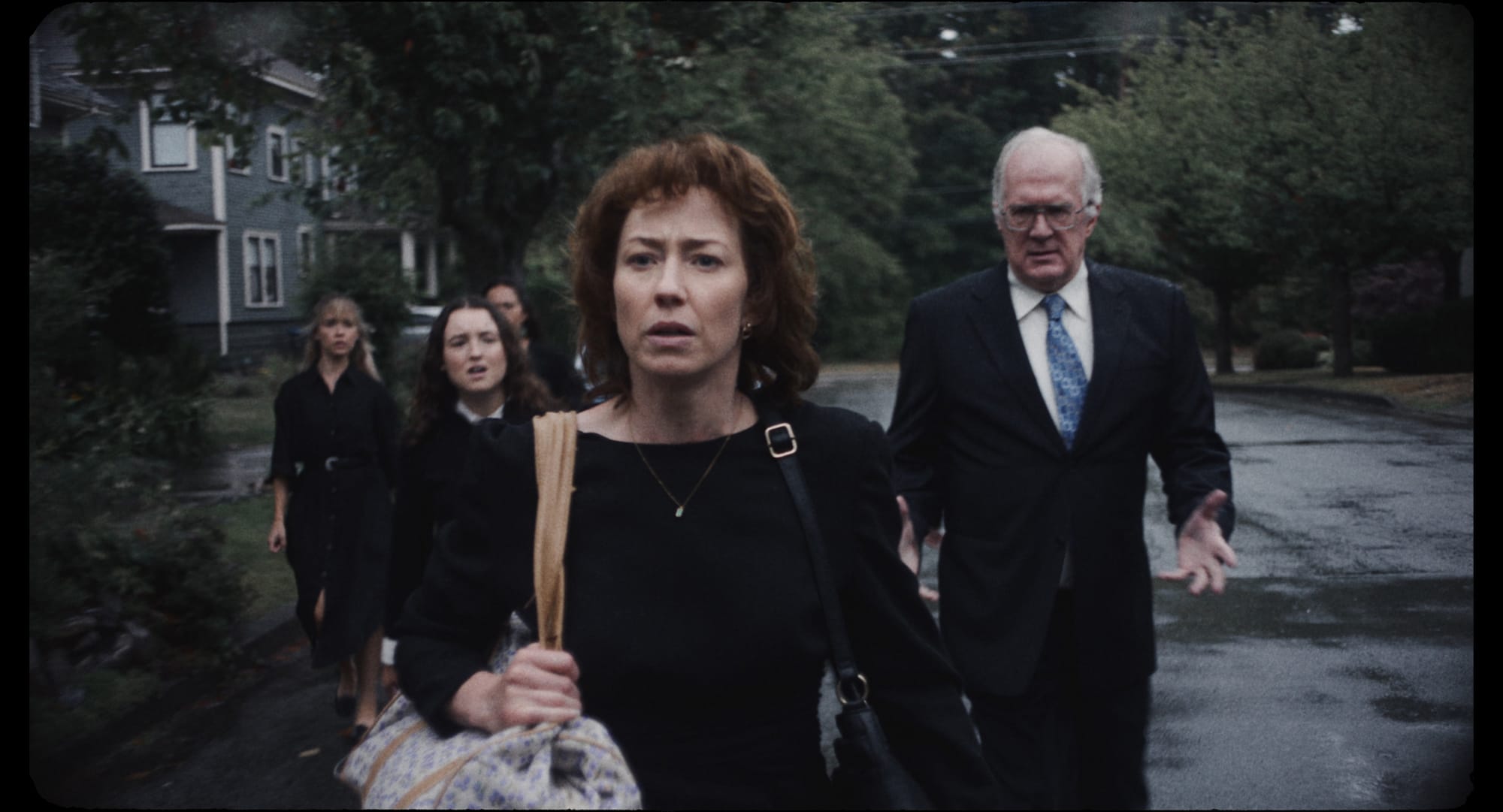
As I joked to Margo after seeing The Liberation, “an Israeli-born director made a movie about a Holocaust survivor joining a cult and I’m not supposed to pull deeper meaning from it?” Guy Nattiv’s last movie was the hagiography Golda starring Helen Mirren as Golda “They Did Not Exist” Meir in a fake nose. He’s returned with this drama about Rita (Carrie Coon), a high-strung bank employee and Holocaust survivor in 1983 New Jersey, who is drawn into a cult by its charismatic leader Ricki (Lily James in a Marina Abramovic wig). The film cuts between a visit to the Bainbridge Island-based cult by her daughters Jo and Ella (Bella Ramsey and Odessa Young) and the story of her recruitment. Rita is visibly oppressed by her status as a survivor, running out of an archival testimony recording and insistent on caring for her senile father (the only other relation of hers to make it out of Europe). What Ricki and her proto-MAHA, all-female cult can offer Rita is a sense of control over her circumstances and a sense of belonging, two things that Rita can’t grasp in her conventional suburban life. In a pivotal fight at her father’s shiva, Rita frames herself as someone who doesn’t get to be happy, which she gets to be in the cult. When her daughters visit her two years later, Ricki’s methods of control are evident, the cult members living in bunks with their hair shorn. Ricki also leads them in mushroom-fueled rituals of ecstatic dancing around a bonfire. Jo goes in with the best of intentions, while Ella is much more skeptical. I’m far from the first person to talk about how Zionism has revealed itself as a separatist cult for Jews spurned by persecution from the West. Instead of building cross-cultural and cross-class solidarity, tons of Jews have used Israel as a way to assimilate into statehood, with all of the violence that entails. I wish I could tell if Nattiv, who notably produced this film with American and Canadian – rather than Israeli – funds, intended to draw this comparison. Is The Liberation, which Nattiv co-wrote with Jaime Ray Newman, an allegorical critique of Zionism’s exploitation of the memory of the Holocaust, or is he just making a cult story? Nattiv has been silent on the plight of Palestinians, and spent most 2023 and 2024 posting endlessly about Nova Festival attendees. The film’s marketing notes that the film is based on a real incident in the life of Nattiv’s survivor grandmother, so it might just be what’s on the tin. But I want to believe that there is more there there. Naturally, Coon’s performance is excellent, as are James and Ramsey. Tracy Letts, to whom Coon is married in real life, is great as Rita’s harried husband Reuben. I really liked the kippah stuck haphazardly on his bald head at his father-in-law’s shiva. The Liberation is a really provocative critique of cult mindset, but the very thing that is provocative about it may not be Nattiv’s intention. By the same token, the fact that I’m still working through this potential reading of The Liberation speaks to some basic strength of the film.
The Man I Love
My final film at CIFF was Ira Sachs’ The Man I Love, an 80s-set drama featuring Rami Malek as fictional theatre artist Jimmy George. As Jimmy embarks on a new project and his AIDS progresses, he takes on a new lover, his downstairs neighbor. I was really moved by Sachs’ last two films Passages and Peter Hujar’s Day, both of which meditated on the interpersonal issues of fiercely independent queer artists. The Man I Love mixes the vivid, desaturated period filmmaking of Peter Hujar’s Day with Passages’ portrait of artistic narcissism, forming a trilogy of sorts. I had heard Digger-level mixed reviews of The Man I Love before my screening, but I’m pleased to report that I very much enjoyed The Man I Love. Malek is in sexy slithery mode as Jimmy, who has recently recovered from a setback with the help of his long-suffering partner Dennis. Around the same time that Jimmy begins devising his stage adaptation of Once Upon a Time in the East, a fairly obscure Quebecois film from 1974, Vincent, a young British man played by newcomer Luther Ford, moves into the apartment below Jimmy and Dennis (Tom Sturridge, slightly overdoing a Noo Yawk accent). Vincent and Jimmy immediately start hooking up, which Dennis is fairly chill about (it’s implied that the couple has been open for a while). Perhaps I’m being aggressive, but Vincent may be one of the stupidest and arrogant characters ever set to film, proudly demanding that Dennis, who has been caring for Jimmy since his diagnosis, back off and keep his nose out of their business. I understand that Sachs is contrasting the brash Vincent with neat and considerate Dennis, but most of his actions played like someone beamed in from Mars. That may be the point, though, as he’s quite young and new to New York in an extremely innovative era for art. The enigma of Vincent notwithstanding, there’s a lot in The Man I Love that works for me. The film is gorgeous, with incredible 80s bohemian ensembles and Josée Deshaies reprising the desaturated, textured Super 35mm look he brought to Passages. Jimmy has several diegetic musical numbers, including an intense performance of “Look What The Did To My Song, Ma” (speaking of Digger) at his parents’ anniversary party. Thankfully, Malek’s work in The Man I Love is a much better container for his skills than Bohemian Rhapsody. Rebecca Hall and Ebon Moss-Bachrach are excellent as Jimmy’s sister and brother-in-law, essentially getting a one-act play within the film where their characters have a painful conversation about Jimmy’s prognosis. The centerpiece of The Man I Love is an extended sequence where, in response to an upstairs neighbor begging them to turn the music down, guests at a dinner party thrown by Jimmy and Dennis each sing a song close to their heart. That sequence plays out in a series of medium shots, highlighting each member of this community without getting treacly. I think Sachs really wanted to make a film about what we owe each other and how we can share parts of ourselves with our community, the strength of this sequence. Zooming in too much on Jimmy and Vincent robs The Man I Love of its potential impact as an ensemble piece. As I mentioned earlier in my section on Elsinore, I love any sort of process drama, so the scenes where Jimmy and his theatre company, The Mechanicals, work as an ensemble on their adaptation of Once Upon a Time in the East really appealed to me. In a Q&A after my screening, Sachs remarked on the challenge of making “a movie about a play about a movie about a play that no one’s ever heard of”, citing the older film’s own adaptation of Michel Tremblay’s plays. Seeing Jimmy at work, as well as some of the product, is enticing, and is perhaps Sachs’ way of asking if Jimmy’s bad behavior might be worth it after all. I don’t expect The Man I Love to be a particularly divisive film upon its release, it’s a lovingly-made Cassavetes riff that will probably work on the arthouse crowd. I’m curious to see if others will be frustrated by the movie’s lack of focus.
That’s my Chicago rundown. Stay tuned for Part 2, where I hit the road with some unexpected guests for Refocus Film Festival in Iowa City.