Midwest Movie Marathon Part Two: Iowa City

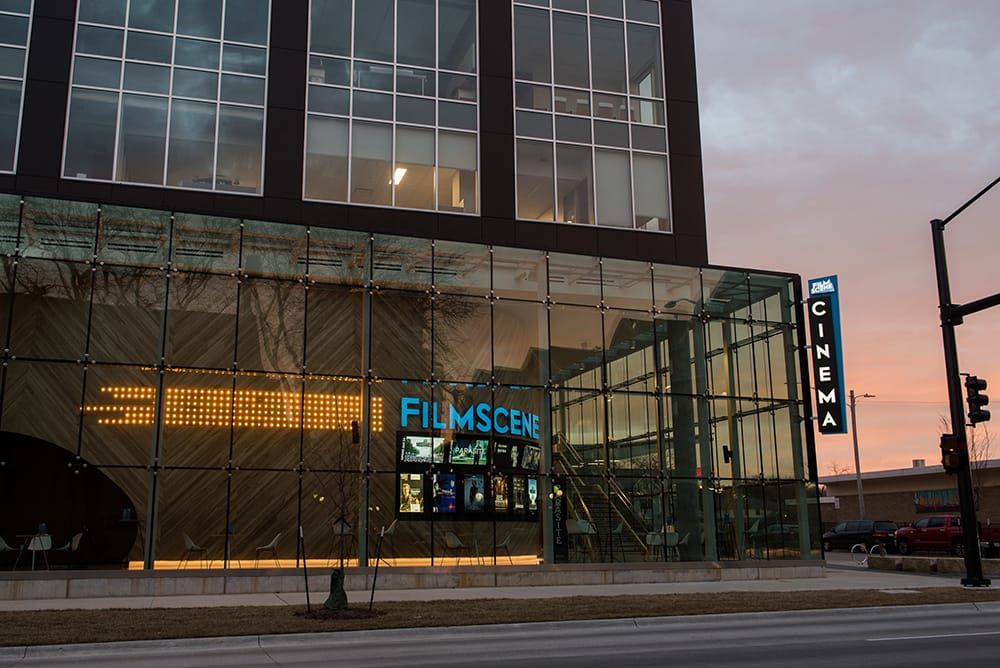
After my cinematic adventures in Chicago, I was very excited to continue my festing in Iowa City, where I lived for nearly five years, at first for grad school and then for work. In a very real way, my roots as a film and theater critic are in Iowa City, so I was eager to revisit and write about Refocus Film Festival. A note of transparency: I worked for FilmScene, the nonprofit cinema that produces Refocus, and helped to program the third edition of the festival. That, of course, has no bearing on my thoughts on this year’s crop of films, but there are definitely warm and fuzzy feelings that influenced my festing. Additionally, Refocus’... well, focus on literary adaptation has always been right up my alley. My fest experience kicked off with quite a surprise when the great Angie Mabeus, FilmScene’s Events Director (whose couch I crashed on for the festival) called me as I was leaving for my last CIFF screening of Arie and Chuko Esiri’s Clarissa. It turned out that two festival guests’ flight from LaGuardia to O’Hare had been delayed, and they would miss their connection to Cedar Rapids Airport. Would I be good enough to take these two guests with me to Iowa City? The most exciting part about this ask, however was that the guests in question were Griffin Newman and Ben Hosley, co-host and producer, respectively, of Blank Check, one of my favorite podcasts for many years. So I cleaned my car out, picked up Ben and Griffin from the airport, and headed west on I-80 with two men whose voices I’ve listened to many times on the drive from Chicago to Iowa City. While Griffin napped most of the time, Ben and I chopped it up and had a lovely ride. Upon our arrival in Iowa City, it we dove headfirst into Refocus, with the opening night screening kicking off at the historic Englert Theater.
A Long Winter
The opening film was the latest from British auteur Andrew Haigh, A Long Winter, adapted from a Colm Tóibín short story about a family in the Pyrenees navigating the disappearance of its matriarch. Haigh has reset the action to 1955 high up in the Rockies, not only a massive win for all of the clotheshorses but a choice that situates the family’s struggles with alcoholism and their elder son’s queerness at the cusp between eras, an “old world” dying and making for a potentially freer and more earnest way of living. Lester and Louise (Ebon Moss-Bachrach and Caitríona Balfe) have a loving relationship, but Louise’s resentment of Lester for moving her to the other side of the mountain, compounded by her compulsive drinking, have chilled the dynamic between them and their adult sons Mike (Fred Hechinger) and Tommy (Kit Connor). When Tommy leaves for Korea, that tension becomes unbearable until Louise vanishes into thin air. I wasn’t totally blown away by Haigh’s adaptation which narrows its focus in the film’s second act to Mike’s efforts to locate his mother. Having now read Tóibín’s short story, I see what Haigh is going for, as the moments that cohered for me least in the film work beautifully on the page. André Turpin’s cinematography is a highlight, rendering the film’s terrain (it was shot in Alberta) in vivid detail on 35mm. Haigh shared in a post-film Q&A that Turpin’s team was the most vulnerable to the elements on the shoot, noting that loading a camera is impossible with hand protection. But they got results. Carol Case’s costumes are also a highlight, a blend of workwear and mid-50s formal worn quite well. Hechinger makes for an affable protagonist, especially as he begins to fall for a local boy played by D’Pharaoh Woon-A-Tai who helps around the house. But Mike is a fairly passive character, taking in the world around him, so Hechinger has a lot to do. By contrast, Moss-Bachrach and Balfe are excellent, alternating their grief and rage with genuine affection for each other. Between his work in this and The Man I Love, I’m glad that Moss-Bachrach has been leveraging his Bear success to deliver deep, complex performances in small films like the ones that launched his career. A Long Winter falls perfectly in the middle for all of the films I’ve seen this festival season, a well-acted family drama that didn’t necessarily blow me away.
All of A Sudden
My introduction to Ryusuke Hamaguchi came in 2021 with Drive My Car, his Oscar-winning adaptation of a Haruki Murakami short story about a grieving theater director. After my first Drive My Car viewing, I had an immediate feeling that this was a filmmaker whose work I needed to follow from there on out. His 2023 film Evil Does Not Exist, a stark drama about the impending climate collapse made with non-professional actors, was a timely follow-up. All of a Sudden shares some DNA with both films, in that it features theater makers working while processing the grief of an impending loss. But All of a Sudden is more invested in caretaking as a theme (you could argue that’s part of the central relationship in Drive My Car), following Marie-Lou, a nursing home director in Paris who develops a close relationship with Mari, a Japanese theater director dying of cancer. All of a Sudden is adapted from You and I, a book of letters between academics Makiko Miyono and Maho Isomo, depicting Miyono’s state of mind as she died of cancer. As Marie-Lou and Mari, Virginie Efira and Tao Okamoto are an incredible pair, each flowing between French, Japanese, and English (both characters are polyglots), developing an almost symbiotic relationship. The friendship that Hamaguchi and co-writer Léa Le Dimna build is unfathomably close; the two seem to read each other’s minds. At some point, I realized that Marie-Lou was speaking to Mari in French as Mari replied in Japanese. The fact that they weren’t even speaking the same language ceased to occur to me as these characters came together. All of a Sudden is a pretty hefty film, coming in at nearly three and a half hours, but between Alan Guichaoua’s airy cinematography and Efira and Okamoto’s performances, the length doesn’t feel punishing. All of a Sudden is a tranquil film about death and dying, a topic so often laden with drama when rendered on film. If you liked Drive My Car, I am pleased to report that Hamaguchi’s newest is exactly what you’re looking for.
La Gradiva
When I was a senior in high school, I went on a school-sponsored trip to Thailand. I was hoping that I would get to partake in some lightly debauched teenage fun, but besides some girls getting drunk in a hotel bathroom of a bottle of vodka our tour guide to bought them and one of my friends hooking up with the guy I was rooming with while I was there, it was a completely normal experience. It was one of the first times I had ever been somewhere with a history that older than 500 years, and the sheer antiquity of the locations we visited sticks with me all these years later. La Gradiva is about a similar kind of trip, taken by a group of French high schoolers to Naples with their Latin class. Loosely based on a French television film, an Arthur Rimbaud poem, and a 1903 novel by Wilhelm Jensen, La Gradiva is written and directed by Marine Atlan, her feature debut. With a cast of mostly amateur actors Atlan has perfectly distilled the sweaty and confusing nature of the end of your teen years, as you’re stuck between childhood and the rest of your life. Atlan focuses on three students, best friends Toni and James and artsy loner Suzanne. We first see Toni hunting for potential hookups on Grindr while James looks on approvingly. Toni claims that he is descended from an aristocratic Italian family, and has joined the trip in order to reconnect with his long-lost family. Despite his purported ties to history, he has absolutely no interest in the academic elements of the trip, instead fucking around and disrupting in the way that only 17 year-old boys can. Atlan doesn’t give us much backstory, keeping us in the here and now of the trip, but details eventually emerge that point to Toni’s unstable home life and tensions between him and the wealthy James. Toni is partnered up with Suzanne, a quiet student who is frequently seen sketching and shows considerable talent. Meanwhile, James is seemingly constantly trying to hook up with someone, rippling through the girls’ monastery room in an excellent gossip scene. It’s a comfort knowing that teens are the same everywhere, even though the teens of La Gradiva get to smoke cigs and drink with their teachers. Atlan has struck gold with her ensemble, putting them to work in dense, Altmanesque scenes at dinner and in museums. One scene, a bar hang that turns into a debate on the rise of the far-right in France, speaks to the political concerns that Atlan has woven into her film about young people. What are we leaving for Gen Z? Will they figure out how to fix things by looking at history? Atlan doesn’t have an answer, with the film closing on narration from Suzanne, our observer. The clash between modern and ancient, and how the ancient can inspire modern thought, is the core of La Gradiva. Atlan’s saturated, grainy cinematography, conceived in collaboration with Pierre Mazoyer, is vital to this theme, lingering lovingly on its locations and the statues the students visit. I got quite swept up in La Gradiva, and I’m excited to see what Marine Atlan has ahead of her.
I See Buildings Fall Like Lightning
I read Keiran Goddard’s novel I See Buildings Fall Like Lightning a few months ago, drawn in by the dynamic title and promised British social-realist drama, and devoured it. Goddard’s prose is full of heart and righteous anger for the global working class. Clio Barnard’s film adaptation immediately became an eagerly anticipated festival title for me, so I practically ran from FilmScene’s flagship location at the Chauncey to the festival pop-up at the Masonic Lodge down the street. Barnard, whose first film The Arbor is an experimental documentary about embattled Yorkshire playwright Andrea Dunbar and the titular council estate where she grew up, works in the tradition of Ken Loach and Andrea Arnold, creating vivid portraits of British working-class life with a deep awareness of and anger about the political dimensions of post-Thatcher England. Buildings is a beautiful match between source material and adaptation, with Enda Walsh’s screenplay activating the visual possibilities of Goddard’s novel which alternates between the internal monologues of five lifelong friends in Birmingham. Shiv and Patrick (Lola Petticrew and Anthony Boyle) have been together since they were teens and are attempting to raise two daughters on Patrick’s Deliveroo wages. Conor (Daryl McCormack) has a kid of his own on the way, and is pouring his life into building an apartment block on the estate that raised them. Meanwhile, Oli (Jay Lycurgo) coasts by as a drug dealer and Rian (Joe Cole) hit the jackpot on the stock market and lives in an icy apartment in London. Goddard’s novel balances this tale of the haves and the have nots by diving deep into these characters’ psyches, so we end up knowing more about them than some of the people in their lives do. Frequently, when I see an adaptation of a beloved novel, there’s always something I loved in the book that is missing (I’m looking at you, The Goldfinch). I’m pleased to report that everything I loved in I See Buildings Fall Like Lightning has made it into Walsh and Barnard’s film version, including Patrick’s hyperfixation on the library van from their childhood and the descriptions of Oli as a beautiful dancer despite his struggles. Barnard also uses music beautifully, both Harry Escott’s score and infusions of grime and house music in the film’s club scenes. The film’s title sequence, of 1990s building demolitions set to pulsating house music, is a distillation of Goddard’s novel’s sense of rage and grief. I was fortunate enough to interview Goddard while I was in Iowa City (more soon), and a lot of my smarter thoughts about Buildings are in that interview, so I’ll leave it there. Some criticism around I See Buildings Fall Like Lightning claims that Barnard’s film is didactic on its central issues, but, frankly, UK austerity (which I think American audiences can relate to) has left such deep scars that anything less would feel unrealistic. I See Buildings Fall Like Lightning does not yet have US distribution, which I hope changes soon so American audiences can feel the heat.
Revolutionaries Never Die
My first doc of the festival was Revolutionaries Never Die, a heartfelt and headlong rush into the archives of Lebanese filmmaker Jocelyne Saab. Saab’s documentaries served as important testimonies of the ravages of American/Israeli overtures on the Middle East, chronicling the role of women in the PLO and PFLP, post-revolution Iran, and Spanish occupation of Western Sahara. Saab’s camera gently floats and focuses on scenes of ordinary people thrust into horrible situations by dint of their location. One particularly revealing scene shows a bunch of Palestinian refugee children in Lebanon playing a game they refer to as “Right-Wing Phalangists Against Palestinians and Leftists”. American children have their own conception of Goods and Bads they work at through play, why wouldn’t that be the case with Palestinian children? Palestinian director Mohamed Yaqubi refers to the film as a “letter” to Saab, with whom he was supposed to collaborate before her death in 2019. Gaza-born Yaqubi reflects on how the images captured by Saab and the ones captured today of Palestine bear more of a resemblance than they should. While I didn’t have any awareness of Saab’s work before I saw Revolutionaries Never Die, I was moved by her fidelity to her subjects. Her steady camera shows life in Palestine and Lebanon, something exceptional (which it shouldn’t be) for a part of the world so often a recipient of the West’s violence.
Faust
I’m not going to pretend like I have some earth-shattering take on F.W. Murnau’s Faust. It’s great! I have a lot of love for German expressionism, and Murnau’s skill for creating images that can leave a 2026 audience asking how he did it is unparalleled. What I can talk about was the live score from ten thousand lakes, the Minneapolis group that is the collaboration of Steven Larsen and Peter Bruhn. Their score for Faust takes cues from the world of ambient music, with an industrial element that gave the score its pulse. I always love a live score, particularly when the musical aesthetic is not continuous with the era that the film is set in. The ambience in the Masonic Lodge was perfect, with flickering wall sconces and esoteric Masonic ephemera lining the walls. Whenever I see Murnau’s films, I leave thinking that we need to send Robert Eggers to the stocks, and that’s what I left Faust thinking.
The Diary of a Chambermaid
Romanian filmmaker Radu Jude’s films are sprawling, messy postmodern comedies where protagonists try to make an impact through art, philanthropy, or good deeds, only for their potential impact to be scuttled by reactionary forces beyond the characters’ control. I was first introduced to Jude’s work at FilmScene, and the potential of another Jude adaptation (I missed his Dracula last year) was deeply exciting. The Diary of a Chambermaid is a “variation” on Octave Mirbeau’s 1900 novel following Gianina, a young Romanian woman working as a domestic in Bourdeaux while also playing the lead in an amateur stage adaptation of the Mirbeau novel. Jude seems to be occupied (as usual) with a great many topics via this adaptation, but the really prominent ones seem to be condescending bourgeois liberals and late-capitalist wage labor. The theater company she works with is run by pretentious French undergrads, and the family that she works for, the Donnadieus, put on a show of conscientiousness while paying her under the table, while requiring massive sacrifices from her. Gianina’s life in France is intercut with FaceTime calls to her young daughter, Maria, who is living with Gianina’s mother back home. These interruptions give us a sense of who/what Gianina is working for, but Maria’s at the age where she is old enough to understand that her mom is far away, but too young to really grasp why. Meanwhile, she is lectured by the Donnadieus for telling a too-scary Romanian folk tale to their son, who insists on calling Gianina “Janine”. Like many bourgeois liberals, their facade of being chill and progressive is belied by their insistence on propriety. Meanwhile, a disastrous dinner sequence tells us a lot about the Donnadieus, where one of their friends pipes up with his take on Romania’s history with antisemitism and the Russo-Ukrainian conflict. Jude’s films tend to peter out after a major third-act conflict, a unique feature that somehow doesn’t feel like a cop out. In The Diary of a Chambermaid, this feels less like he forgot to write an ending and more like him pointing out that there are thousands of Gianinas, sacrificing their happiness and family ties for much wealthier people’s comfort with little thanks. In that sense, Jude is actually hewing closely to Mirbeau’s vision of a young domestic worker used up by her employers, albeit with the smirk he layers into all of his work.
Once Upon a Time in Harlem
Once Upon a Time in Harlem is a beautiful window into a unique event, a reunion of figures from the Harlem Renaissance in 1972. Rescued by David Greaves from the archives of his father, experimental documentarian William Greaves, Once Upon a Time in Harlem is unique as a double-portal through history. We, in 2026, get transported back to 1972 where we get to watch figures talk about events that they lived through in the 1920s and 1930s. Greaves is best known for Symbiopsychotaxiplasm, an experimental verité documentary where he depicts the filming of a fake documentary directed by an incompetent director named William Greaves. Primarily an experiment in filming genuine reactions in Symbiopsychotaxiplasm, the same style is used to a gentler effect here, a means of creating a genuine fly-on-the-wall experience for its audience. The 1972 session, held at the Harlem townhome of Duke Ellington (who is absent from the proceedings for unexplained reasons), featured guests such as Romare Bearden, Gerri Major, and Leigh Whipple, who spend the runtime kibitzing and rattling off lists of first and last names. Greaves and crew will often supply the attendees with questions about times and places, but Once Upon a Time in Harlem is spectacularly freewheeling. Greaves hadn’t done much with the footage before he passed away in 2014, but its contemporary restoration is a gift and a reminder to think deeply about the contributions of Black artists to American culture. In a time where any sort of cultural specificity is seen as a threat by artistic gatekeepers, a film where pioneering Black artists talk about a hugely productive Black art movement is the programming we need. Outside of the historical value of Once Upon a Time in Harlem, it’s also a great hang, a reunion where folks come together, look back, and talk over each other. How lucky are we to witness it?
Rehearsals for a Revolution
Rehearsals for a Revolution is an extremely personal film for documentarian Pegah Ahangarani. Ahangarani’s father was a cinematographer who dedicated himself to Khomeini’s early reign, only to become disillusioned after a close friend became a target. Ahangarani’s mother was a filmmaker in her own right, which lead Ahangarani to a career as a child actress in 1980s Iran. As we follow Ahangarani through the end of the 20th century and into the early 2010s, we see a young activist emerge, pushed and pulled by the destabilizing forces in the Middle East that culminated in the Arab Spring. Using archival material, she revisits five moments of political upheaval in her native Iran, the titular “revolutions”. In the film’s most affecting sequence, Ahangarani uses footage she shot on a standard point-and-shoot of a 2009 protest in Tehran, placing the audience in the middle of the turmoil. We’re then pulled to 2025, where we see Ahangarani’s attempts to finish the film in her new home in the UK thwarted by the Iranian crackdown on 2025 protests. Ahangarani makes clear that it’s near-impossible to make a film about an unresolved historical situation, which is incidentally the film’s greatest flaw. The vignette style of the film feels at times like several short documentaries stitched together, a spottiness exacerbated by the film’s open ending (necessitated by the continued activity fomented by the U.S.) I’m a firm believer that any political art is best served by distance from the subject, so it’s unfortunate that Rehearsals for a Revolution is so beholden to both Ahangarani’s family ties and the sheer fact that the book won’t close on Iran any time soon. Rehearsals for a Revolution is a good documentary, it just feels unfinished.
The Garbage Pail Kids Movie
What if I closed this with a careful critical consideration of The Garbage Pail Kids Movie? I’m not doing that, but what if I did? Rod Amateau’s cinematic treatment of the infamously disgusting trading card game was selected by Griffin Newman and Ben Hosley of Blank Check with an assist from critic and Iowa City native Emily Yoshida (known as the Mother of Blankies to die-hard Blank Check heads). Horrifying prosthetic photo-real facsimiles of the Kids help Mackenzie Astin, who works for an eccentric British antique store owner (Anthony Newley) face off against sadistic adult bullies. There’s a mall fashion show involved and a climactic fart. It was perfect subject material for a live Blank Check, with Newman, the tie-in merchandise expert, and Hosley, the fashion expert, weighing in with Yoshida on the mess we saw. This last entry is really more a reflection on the time I spent at Refocus, the festival that introduced me to film festivals. As Refocus and my beloved FilmScene reach new heights, it was so lovely to be reunited with old friends, make new ones, and to see how Iowa City’s arts community comes out strong for Refocus. At every event I attended, the theater was full to bursting and abuzz with excitement. The fact that Refocus got people out for a movie as mind-numbing and gross as The Garbage Pail Kids Movie is a testament to what they’ve got going on. After my Midwest festival double-header of CIFF and Refocus, I’ll say this. Don’t underestimate the Midwest film community. We are rock-solid and passionate audience members. Until next year…