Turn, Turn, Turn

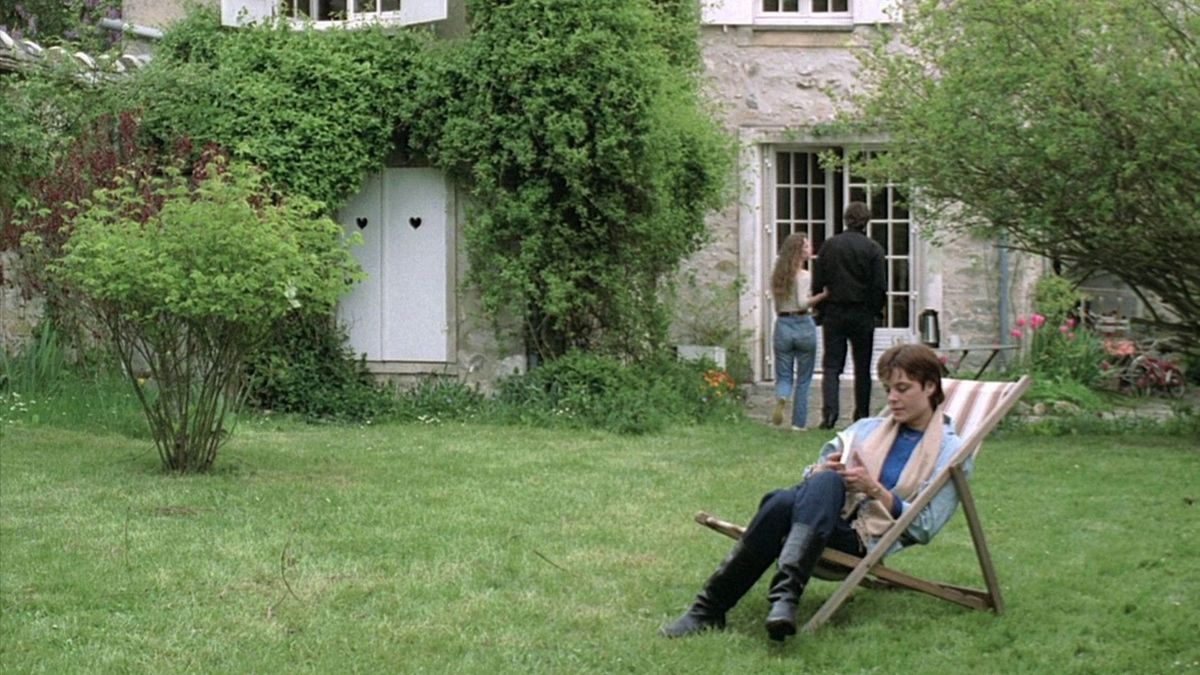
In a stroke of programming genius, the Gene Siskel Film Center here in Chicago turns its screens over to long watches every January with their Settle In series. Last month, I used the inclusion of Éric Rohmer’s Tales of the Four Seasons in the series as an excuse to immerse myself in the director’s work. Other than catching a Criterion 24/7 showing of Claire’s Knee last fall, I’ve had no exposure to Rohmer’s work. I knew of his reputation as a contradictory force within the French New Wave’s roster of enfants terrible, as well as his influence on many contemporary filmmakers like Annie Baker and Ira Sachs. Technically, these are four different films, made across the entirety of the 1990s with different casts. In order of release, they are A Tale of Springtime (1990), A Tale of Winter (1992), A Summer’s Tale (1996), and Autumn Tale (1999). Watching Tales of the Four Seasons back-to-back, I dove into the work of Rohmer, who died in 2010, a journey through a beguiling cycle of films where still waters run deep.
The first in the series, Springtime chronicles the beginning of a friendship between Jeanne, a reserved high school philosophy teacher, and Natacha, an 18-year-old pianist she meets at a party in the suburbs. Natacha is peppy but obviously lonely. While she non-committally dates a journalist old enough to be her father, she is navigating a terse relationship with, you guessed it, her father Igor, himself dating a writer young enough to be his daughter. Ah, the French! When she drives Natacha back to Paris and crashes at her childhood home (avoiding the empty apartment she shares with her out-of-town boyfriend), Jeanne wanders into this thicket. The women become fast friends, Natacha avidly sharing with Jeanne the story of her mother’s departure as well as her frustrations with Éve, Igor’s girlfriend.
After a trip to the family’s neglected country home, and a few tense dinners, it becomes clear that Natacha is looking for a stepmother, if not a replacement for Éve, in Jeanne. One of the most fascinating elements of Rohmer’s style is how emotionally remote his screenplays are. Springtime points to Natacha’s possible Electra complex, but doesn’t force the issue. It’s also intriguing that Jeanne becomes a surrogate mother figure for Natasha when she herself is in her mid-20s, yet not surprising given her vocation.
As Jeanne is slowly pulled into Natasha and Igor’s slow-burning domestic drama, she suggests that Natacha be realistic about Igor and Éve’s relationship. This leads to a rift between the two which is resolved when Natasha finds an heirloom she thought Éve had stolen. In a very real way, these films are comedies, particularly in the sense that the endings are always a return to the status quo.
Rohmer’s reverence for classical form is evident in A Tale of Winter. The second Tale not only references Shakespeare’s The Winter’s Tale in its title, but also features a performance of Shakespeare’s pastoral comedy in a pivotal scene. After a passionate summer romance, Félicie and Charles go their separate ways and plan to reconnect as soon as they can. Through careful exposition, we learn that, not only did they conceive a now 5-year-old child, Elise, but Félicie accidentally gave Charles the wrong address all those years ago. Elise is being raised by her grandmother in the Paris suburbs while Félicie works as a hairdresser in the city. Félicie must also balance dueling romantic entanglements with her boss, Maxence, and Loïc, a meek librarian.
Félicie is extremely blunt and headstrong, holding herself to rashly-made decisions and then immediately going back on them. This makes Félicie a frustrating and endearing heroine, unaware that half-measures are occasionally okay. The dash of Shakespeare comes when she accompanies Loïc to a performance of The Winter’s Tale, and is moved to tears by the play’s climax. In Shakespeare’s play, the deceased queen Hermione’s statue comes to life when the shepherd girl Perdita reveals that she is the daughter that Hermione and Leontes lost many years ago. Rohmer’s plot then responds to Shakespeare’s miraculous ending in its last act, which you may guess but I couldn’t spoil here. Taken outside of the context of its classical leanings, Winter feels like an expression of the frustrations at the core of one’s early twenties, where you feel like every choice you make will follow you for the rest of your life. This sentiment is all the more impressive given that Rohmer was 72 when he made Winter.
Immovable personalities and relationships are also the focus of Summer, which follows a young man Gaspard vacationing alone in Brittany. Gaspard, a sullen aspiring musician with a master’s degree in math, feels at a crossroads as he waits to start a job in Nantes. Using title cards that announce the date of each scene, Rohmer follows Gaspard through the first few days of his vacation, as he walks the beach and tries to write music in a family friend’s empty house. Summer after Winter makes for a fascinating contrast in personalities as well as weather. Where Félicie is direct, saying everything she thinks and feels, even when she contradicts herself, Gaspard is (to put it lightly) reserved. He doesn’t say a word until seven minutes into the film. His distance, as well as his reluctance to share his thoughts eventually gets him in trouble.
Gaspard tangles himself in three summer relationships, starting with an intense platonic one (that also includes kissing) with Margot, a spunky waitress with an ethnomusicology. His promise of writing a sea shanty for his girlfriend-not-really Léna backfires on him when he offers the song to Soléne, a local he has the hots for, only for Léna to show up in Brittany weeks later than she had promised. The situation gets messier until Gaspard finds a convenient reason to quietly slip away from the resort town. Rather than face the calamity caused by his anxiety, he just sails away. Tales of the Four Seasons is full of avoidant behaviors, and the final installment is its apex.
The most straightforward comedy of the bunch, Autumn balances a wedding, false identities, and the existential dread of middle age. Magali, a widowed winemaker, gets caught between various friends’ machinations to get her back in the dating pool. In the interest of vetting dates, her married friend Isabelle goes on several dates with a man named Gérald, posing as Magali. Meanwhile her son’s girlfriend Rosine tries to get Étienne, her former teacher, to consider a date with Magali.
This is complicated by the fact that the classically, oh-so-Frenchly horny Étienne still wants to sleep with Rosine (it’s implied that they used to hook up, but after she graduated, so it’s FINE). The intrigue comes to a head at Isabelle’s daughter’s wedding, where both suitors seemingly strike out with the temperamental Magali. While she appreciates her loved ones’ attempts, she is furious that all of the setting-up happened behind her back. After demanding Gérald drive her to the train station in the middle of the reception so she can visit her daughter, she realizes how rude she was to him and returns to the wedding, dancing with an uncertain look on her face.
Rohmer himself was an intensely private man, so the biographical supposition that comes with analyzing most auteurs is tricky. What we can learn about Rohmer is found between the lines of his films. His other formal experiment, Six Moral Tales (which includes Claire’s Knee), consists of six films that all follow the same broad plot; a man is tempted to cheat, but doesn’t. Even if it’s hack to say that any filmmaker is concerned with human behavior, I would still say that Rohmer’s films are about human behavior. Why else would he continually return to these plots and questions? There was something about free will and self-possession that fascinated him, so he ran the same experiment over and over again. In Tales of the Four Seasons, this scientific approach is filtered through his reserved directorial style so the viewer feels as if they are looking in on specimens performing responding to experiments.
All four films start in relative silence, most notably Summer’s opening seven minutes, scored solely by beach sounds. Only Springtime, the first of these experiments, features non-diegetic music in its opening sequence, Beethoven’s Sonata no. 5 in F major. It seems that Rohmer was less interested in traditional “backwards and forwards” storytelling, with triumphant openings and heartfelt endings, but instead what happens when people intersect. He would have loved The Sims. But that’s not to say Tales of the Four Seasons is devoid of conflict. Each film features characters butting heads as they deliver dueling monologues stuffed with their worldviews and philosophies. Ever the intellectual, Rohmer lets his characters express themselves through what they know, rather than what they feel.
There is no stronger example than a scene in Springtime, where Jeanne and Éve vigorously debate Kant over dinner. The debate comes to represent a sort of proxy battle between father and daughter, Jeanne egged on by Natasha in order to get under Éve’s skin. Éve attempts to pull rank, touting the MA in philosophy she’s working on, but Jeanne simply outmaneuvers her. Intellectual pursuits are paramount to Rohmer’s people. In Summer, Margot lets Gaspard into her orbit by allowing him to accompany her on field work in rural Brittany. But Rohmer doesn’t distinguish between the importance of artistic, intellectual, and occupational pursuits. Gaspard’s songwriting (there was apparently a “pirate-rock” trend in ‘90s France) and Magali’s viticulture are given the same weight, and their conversations with others on those topics are deeply vulnerable.
Even though he was considered by many to be a small-c conservative and was known to be a devout Catholic, Rohmer’s films were quite plainly about sex. Trying to set loved ones up with new partners, trying to find or avoid a summer fling, searching for a stable partner, his protagonists are all occupied with sex in some capacity. The only actual sex we see in the Tales is between Félicie and Charles at the very beginning of Winter, presumably the encounter that led to Elise’s conception. There’s some heavy petting in Summer, but it goes no further as a result of Soléne’s convictions. What works is that Rohmer understands the eroticism of flirting, and how that tension (one may even say frisson) can be as exciting as sex itself.
It’s clear that Isabelle only goes on the dates as Magali in Autumn because she misses the excitement of flirting after years of a stable marriage. Given how austere the Tales of the Four Seasons are, it does feel surprising to focus about how sex-driven their plots are. But that absolutely falls in line with the read that Rohmer was obsessed with human behavior and interaction. Isn’t it fascinating that we want to do these things to each other?
As I wandered out of the Siskel after 8 hours and change of Tales of the Four Seasons, I found myself thinking about the idea of deceptive simplicity. The plots of the Tales are simple, and the filmmaking style is spare. The best realist filmmaking feels like looking at people living their lives through a window without any editorializing. With his films, Éric Rohmer cultivated a body of work that reflects a fascination with human interaction. To live through a year with Rohmer, to watch Tales of the Four Seasons all at once, is to read a case study on why humans are so interesting.